















PROVEN SOLUTIONS
Systems that have been implemented successfully in real businesses, distilled by members into guides you can follow. These are examples — not limits.

Learn from systems that already run
Each solution below comes from a system operating in a business in Vietnam. Results are described qualitatively; figures are only published when they can be verified. Việt Kai — a founding member of the community — is named with its owner's consent; other businesses stay anonymous until written consent exists. These solutions are a starting point, not a limit: Agentic AI and automation have endless applications, and members can develop AI from your own ideas, tailored to your industry and the size of your business.
MEMBER STORY
Việt Kai — Vietnam's leading leather supplier runs the whole business on AI, SEO, CRM and ERP
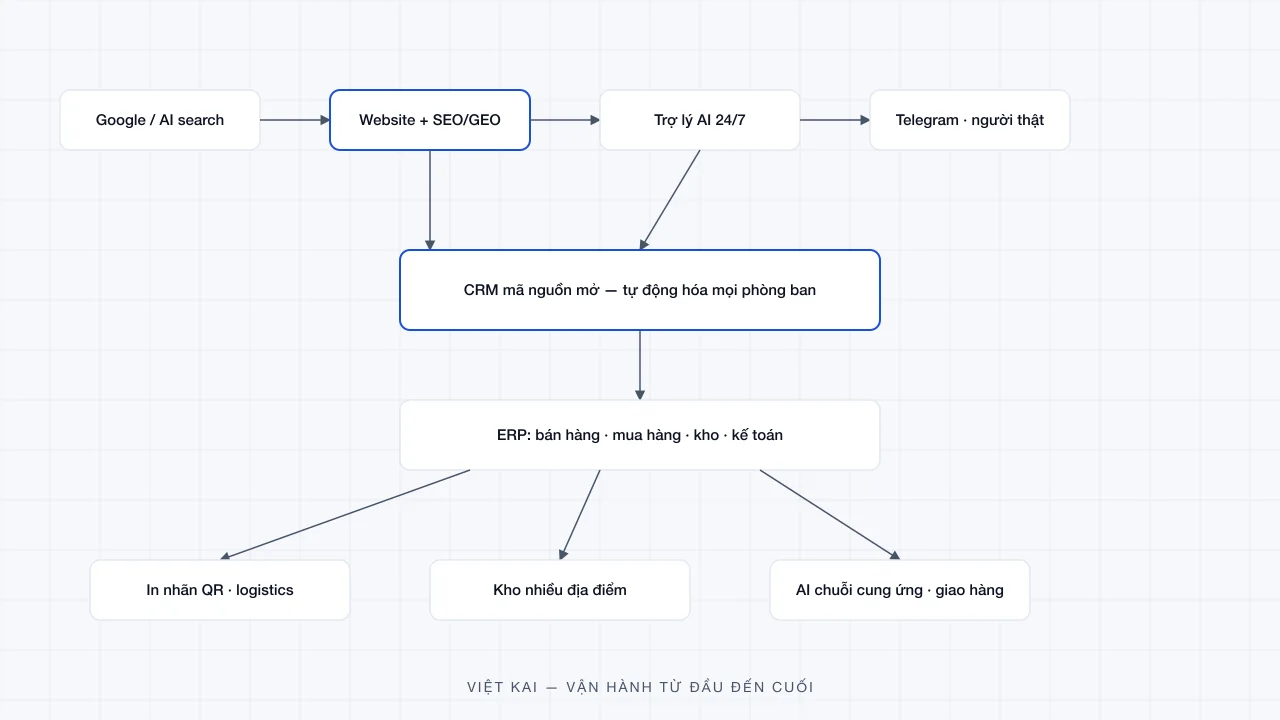
The problem. A microfiber, PU, PVC leather and upholstery-fabric supplier in Ho Chi Minh City (vietkai.com), founded by business owners from China, with 1,000+ workshop partners, warehouses in five cities and exports to eight markets — but about 40 staff and no IT department. Customers search Google and ask AI for suppliers; orders, stock and deliveries still lived in spreadsheets and chat messages.
The system. An SEO/GEO-ready website that tops Google and is recommended by AI platforms; an AI assistant on the site supporting customers 24/7 with human handoff via Telegram; every lead flowing straight into an open-source CRM that automates every department's process; an ERP linking sales, purchasing, warehouse and accounting; QR label printing for logistics; AI forecasting in the supply chain; multi-site warehouse management and delivery tracking.
Implementation steps:
- Rebuild the website with structured data, multiple languages and content AI engines can cite
- Add an AI assistant with the company's own context and human handoff via Telegram
- Route forms, chat and email into an open-source CRM with spam scoring and campaign attribution
- Connect the ERP, print QR labels on receipt, scan by location, batch, dispatch and delivery
- Add AI demand forecasting and bottleneck alerts in the supply chain
What to expect:
- Top 3 on Google for 20+ core keywords; organic traffic up 180% after 12 months (illustrative figures, being updated)
- 65% of leads from search and AI with no paid ads; 1,200+ AI conversations a year, 40% outside office hours
- 100% of leads enter the CRM automatically; five departments on one real-time dataset
- Stock-count variance under 1% across 200,000 m; order handling time down 40%
Technology: Next.js · Gemini · Telegram · Open-source CRM · ERP · QR labels · PostgreSQL · Google Cloud · Vercel
SYSTEMS
CRM for a distribution business: from Excel and Zalo to a system the sales team actually uses
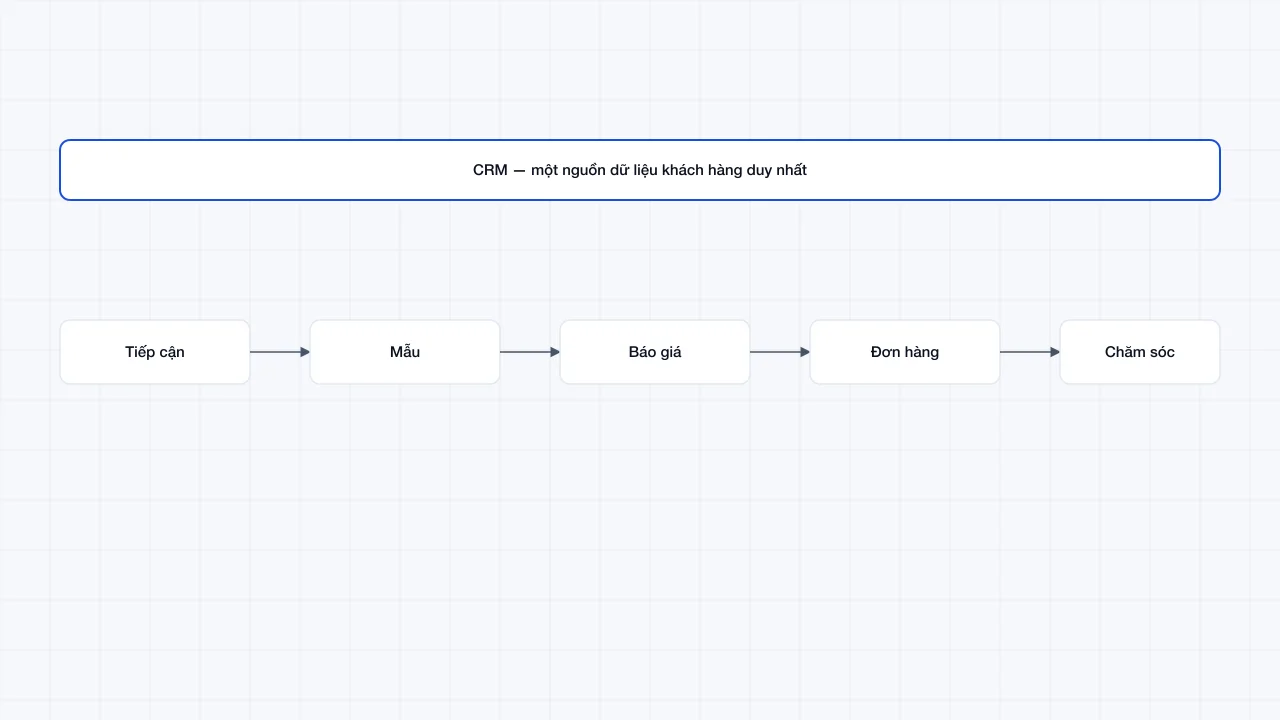
The problem. A distributor with a specific sales process: samples, project quotes, multi-tier dealers. Customers scattered across Excel, Zalo and each rep's notebook. Off-the-shelf CRM was tried twice; both times the team went back to the old way.
The system. A CRM configured to how the sales team really works: a project-based pipeline, fields for samples and quotes, permissions by region. Only the screens used every day are kept.
Implementation steps:
- Observe how the sales team actually works before choosing a tool
- Design the data model around that process, then configure the CRM
- Migrate data from Excel and chat, reconciling with each owner
- Train in one session; monitor the first two weeks and adjust
What to expect:
- The sales team uses the CRM daily instead of Excel and Zalo
- Customer history, samples and quotes live in one place
- Management sees the whole pipeline in real time
Technology: Open-source CRM · PostgreSQL · Next.js · Google Cloud
APPLIED AI
AI stock and supply-chain monitoring for a materials supplier
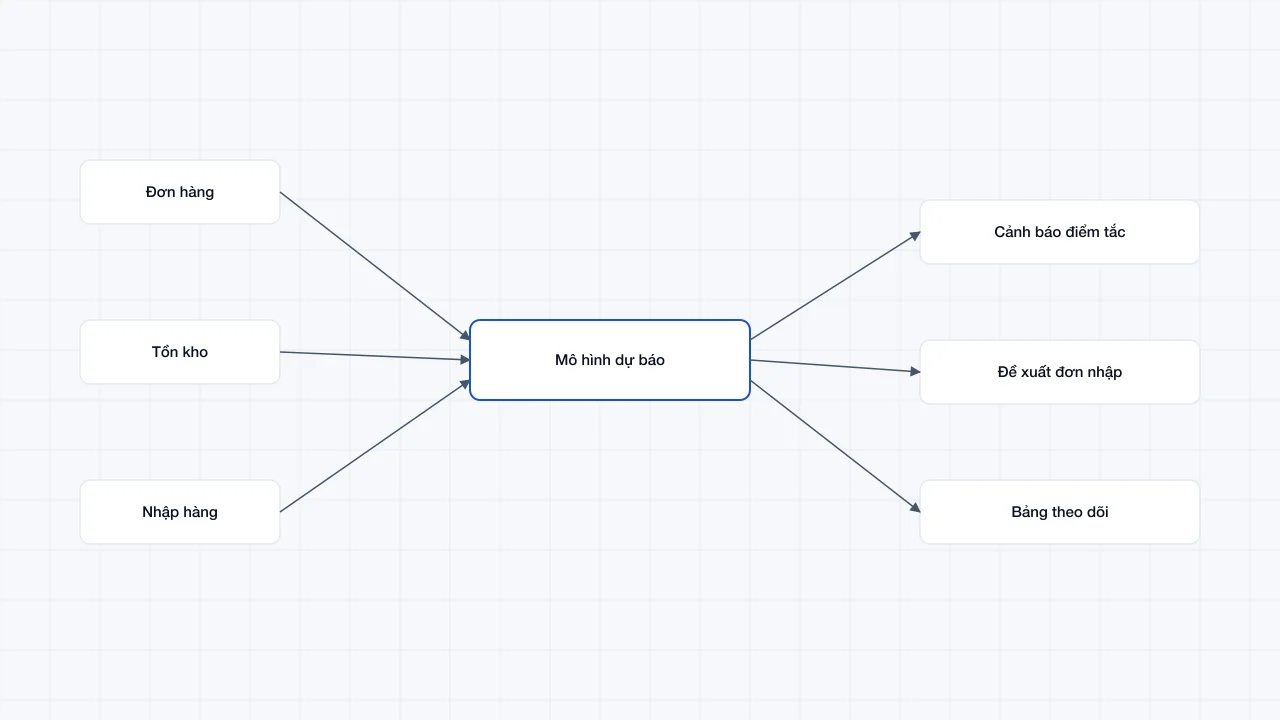
The problem. Hundreds of SKUs, several warehouses, imported supply with long lead times. Stock tracked in spreadsheets, updated weekly; stock-outs and overstock happening at the same time on different SKUs.
The system. One shared database for stock, orders and purchases; a demand-forecasting model per SKU; bottleneck alerts based on each supplier's lead time; a dashboard with suggested purchase orders for a person to approve.
Implementation steps:
- Collect and clean stock, order and purchase data
- Build the forecast model and alert thresholds; run in parallel for a month
- Build the dashboard and purchase-approval flow
- Train warehouse and purchasing staff; hand over documentation
What to expect:
- Stock updated continuously instead of weekly
- Bottlenecks flagged before they hit the warehouse
- Purchasing decisions based on data instead of memory
Technology: Python · PostgreSQL · Google Cloud · Forecasting model · LLM
E-COMMERCE
Online store and Amazon storefront for a B2B business going online for the first time
The problem. A B2B business selling through reps and dealers with no online channel. A product catalogue with many variants and no standard structure; the people who will run the store are the sales team, not engineers.
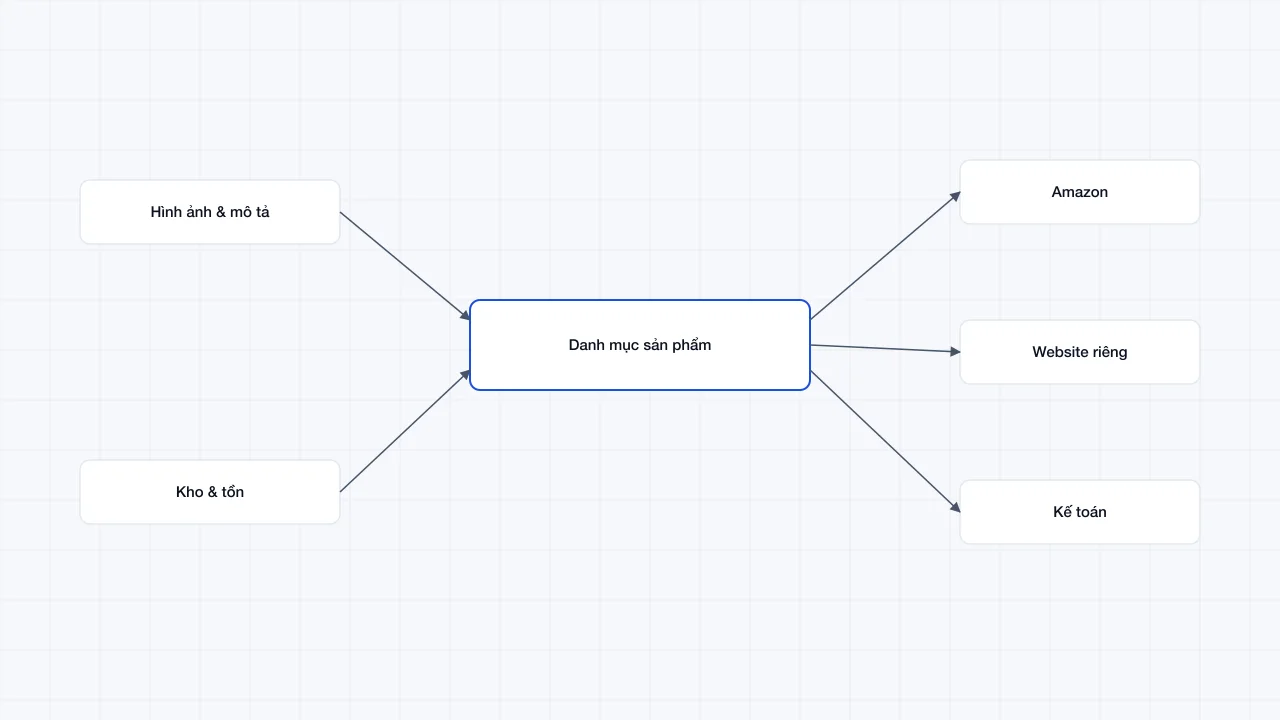
The system. A central product catalogue as the single source, feeding both the Amazon storefront and the company's own store. Order flow connected to existing stock and accounting; inventory synced across channels.
Implementation steps:
- Standardise the catalogue to marketplace requirements
- Set up the Amazon storefront and the online store from the same catalogue
- Connect order flow to stock, accounting and shipping
- Train the sales team to run the store daily
What to expect:
- Amazon and the online store run on one catalogue
- Online orders flow into existing stock and accounting processes
- The sales team runs the store on its own after training
Technology: Amazon Seller Central · Next.js · PostgreSQL · Google Cloud
INFRASTRUCTURE
Moving a manufacturer's entire IT infrastructure to the cloud
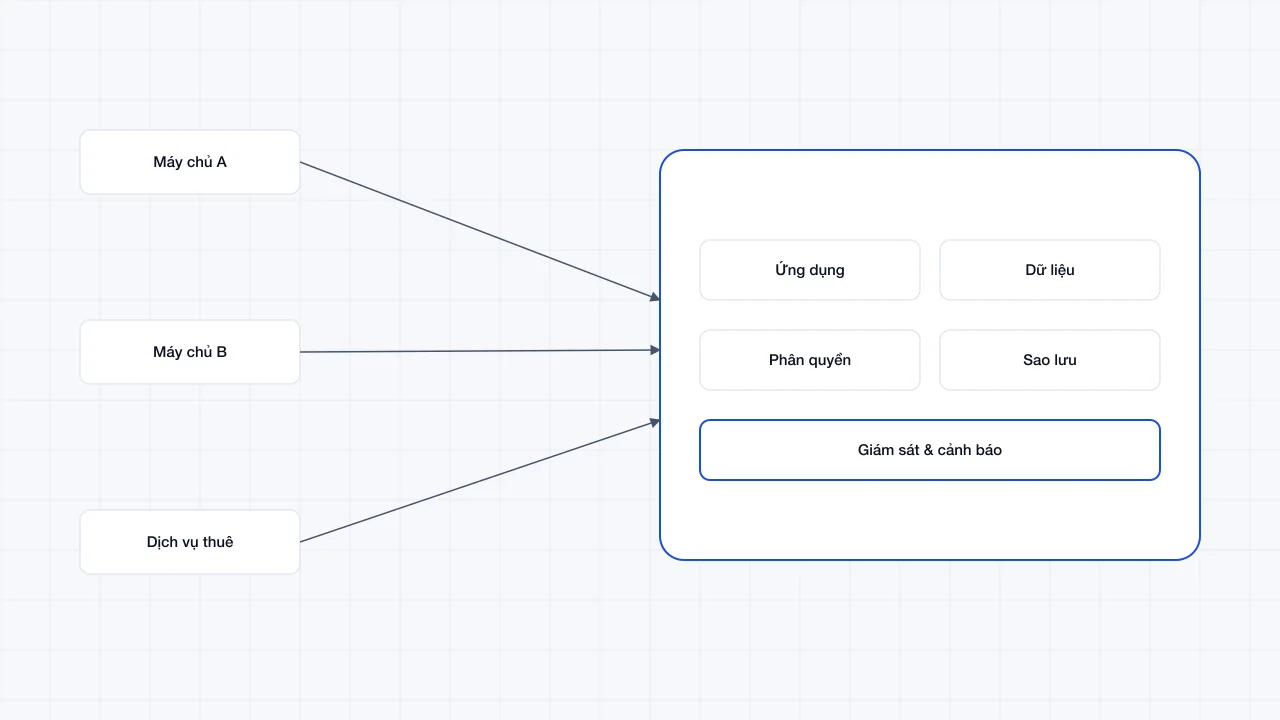
The problem. On-premise servers plus scattered rented services; one account per system, manual backups, no central monitoring. Export growth raised data-security requirements beyond what the old setup could meet. No in-house IT.
The system. A target architecture on Google Cloud with role-based access, two-factor authentication, automated backups and monitored alerts. Accounts and billing in the business's name; predictable monthly cost.
Implementation steps:
- Inventory every application, dataset and account
- Design the target architecture and a per-system migration plan
- Migrate one system at a time, run in parallel, reconcile before cut-over
- Set up backups and monitoring; write operating docs; train staff
What to expect:
- All infrastructure on one platform, owned by the business
- Role-based access and automated backups
- Operations staff handle daily tasks without calling anyone back
Technology: Google Cloud · PostgreSQL · Linux · Cloud Monitoring · IAM
AGENTIC AI IN DAILY OPERATIONS
Work AI agents can do for you, end to end
The work that repeats every day — customer follow-up, online bookings and orders, quotations, invoices, collections, bank reconciliation, warehouse, inventory and supply chain — can be carried out by AI agents from start to finish. People set the rules, approve exceptions and supervise. These are only a few examples; the applications are endless.
Scheduled customer follow-up
Agents send emails, Zalo and WhatsApp messages on a schedule: chasing unanswered quotations, thanking customers after a purchase, checking in with customers who have not ordered in a while. Messages are personalised from each customer’s CRM history; when a customer replies, the agent carries on the conversation or hands it to the account owner.
Answering customer questions 24/7
Agents read product documents, policies, stock levels and order history to answer customers on the website, Zalo, Messenger and WhatsApp — at any hour. Questions outside their scope go straight to a person, with a summary attached.
Preparing and sending quotations
From a customer request, the agent checks the price list, customer-group discounts, stock and lead times, builds the quotation in the company template and sends it. Quotations above a value threshold go to an approver first.
Processing orders
Once the customer accepts the quotation, the agent creates the order in the ERP, reserves stock, schedules delivery, confirms with the customer and keeps the status updated until delivery is complete.
Issuing invoices
When an order is delivered, the agent issues the e-invoice, sends it to the customer and records the receivable in the accounting system — nobody re-types the data.
Chasing invoice payments
Agents track the due date of every invoice, send escalating reminders by email, Zalo and WhatsApp, log each customer’s promise to pay and flag to accounting the accounts that need a person.
Reconciling bank accounts and transactions
Agents pull bank statements and transactions, match them against invoices and receivables, post the matched entries and surface only the differences for people to resolve — fully autonomously.
Running the warehouse
Agents coordinate receiving, dispatch and transfers from the orders: they create pick lists, suggest storage locations, print QR labels, match every scan against the documents and flag discrepancies the moment they appear.
Controlling inventory
Agents track stock in real time across every warehouse, forecast demand per SKU, flag items running low or sitting too long, and propose replenishment or transfers between warehouses on their own.
Orchestrating the supply chain
Agents raise purchase orders from stock thresholds and each supplier’s lead time, track production, shipping and customs clearance, flag bottlenecks and update arrival dates for sales and customers.
Booking pages on web and mobile
A booking page on your website and mobile app for spas, salons, clinics, dental practices, restaurants, hotels, training centres, repair services and more. Agents take the booking, check staff and room availability, confirm by Zalo, SMS or email, send reminders before the appointment, handle changes and cancellations, and collect deposits.
An online store that takes orders and bookings itself
An e-commerce website for retail, fashion, cosmetics, food, furniture, materials or B2B distribution. Agents receive orders and pre-orders, confirm payment, deduct stock, create shipments with the delivery carrier, keep customers updated and handle returns according to your policy.
And your own idea
Agentic AI is not limited to the examples above. Tell us your problem or idea — the community helps develop AI agents tailored to your industry and the size of your business.
Share your idea
SEE A REAL SYSTEM RUNNING
Book 30 minutes to see a real showcase
Not slides. You see a system that runs every day at an industry-leading company: the CRM, autonomous workflows, an Agentic AI deployment and AI agents at work in accounting, sales, marketing, operations, warehouse management, logistics and the supply chain.
- Accounting
- Sales
- Marketing
- Operations
- Warehouse management
- Logistics
- Supply chain
Choose a format
Online · 30 minutes
On Google Meet, from anywhere.
In person at the RethinkStack office
76 Tam Dao, Dien Hong Ward, Ho Chi Minh City
Free, no obligation.
Is your problem like one of these — or completely different?
Even better. The applications of Agentic AI and automation are not limited to what is shown here. Join and tell us your idea: a member who has implemented a similar system will talk with you for 45 minutes and send a written summary of how to develop AI for your exact business problem — whatever your industry or size.